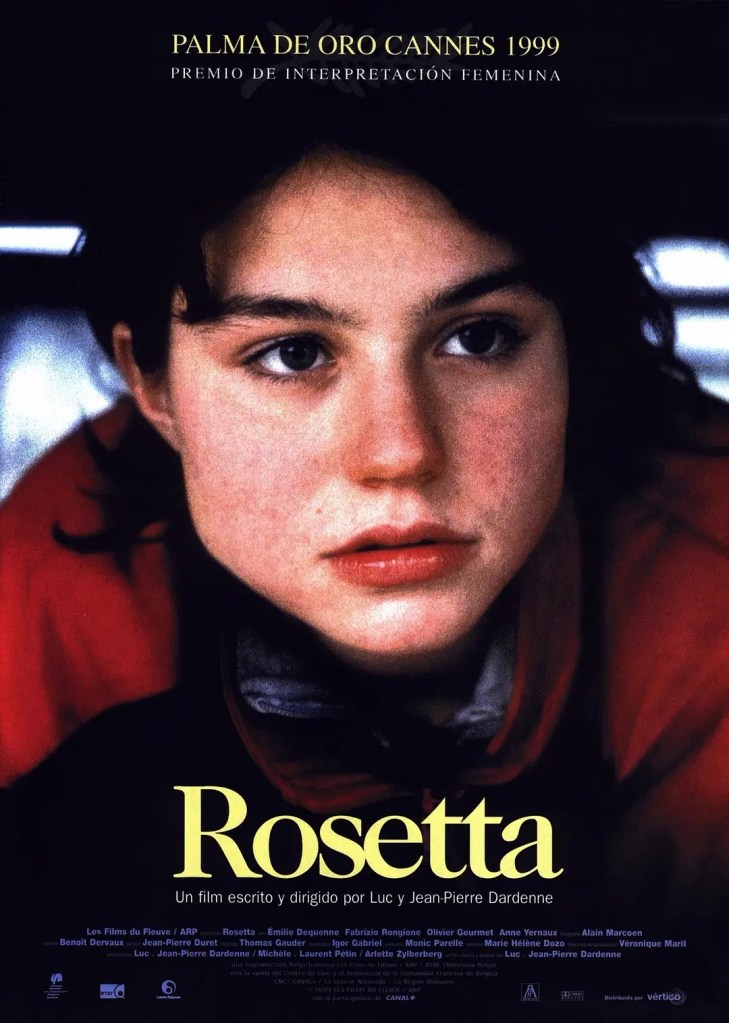
This blog will explore the Dardenne brothers’ emphasis on physical movement and the film’s handheld approach, based on a review of <Rosetta> on Douban. Most film fans of <Rosetta> have mentioned the ability of physical movement to express the spiritual world in their reviews of the film. Some fans wrote that the movie “responds to mental activities and changes with physical movements” and “does not explain or illustrate the protagonist’s inner activities”. People have found that the Dardenne brothers give more attention to the actors’ physical movements than to their words during the shooting process. The shooting method of the film is also widely discussed, with some viewers repeatedly mentioning that the Dardenne brothers used handheld photography to shoot the film, which they believed contained too much emotion, while others held the opposite opinion and thought it had a very uncomfortable feeling.
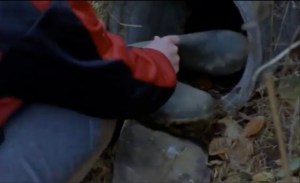
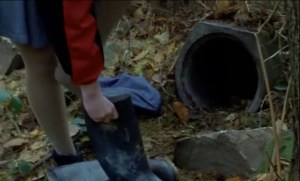
Firstly, the Dardenne brothers train the screened actors before the official start of filming. But surprisingly, they hardly rehearse the dialogue, in order to create a rhythm they almost only ask the actors to perform physical movements, and expect the actors can give the right reaction (Mosley, 2013). After this constant rehearsal until the actors’ movements become natural, these movements, which do not need to be thought through, can be recorded by the camera.
This goes hand in hand with their realistic subject matter, because the actor’s deliberate actions to perform a role are always less likely to impress the audience off camera than the natural behavior. A good director will try to eliminate the distance between the audience and the action, destroying the screen into a picture frame and dragging the audience into the realistic scene. (Roemer, 1966) The Dardenne brothers’ emphasis on the actors’ body language is one of the best ways to eliminate the distance, the audience sees the most natural, the most relevant to the characters, the most often occurring, and naturally, it is easier to enter the plot and even the characters inside. In addition, the Dardenne brothers insist on shooting scenes in chronological order (Mosley, 2013), because this way the development of the plot and the relationship between the characters can gradually accumulate, until the final scene in the explosion. And Dardenne also believes that continuous filming enables the natural emergence of an ending that has undergone a full shooting time to develop and mature (Dardenne, 2005). In this way, all the actors’ emotions, actions and endings are formed through the accumulation of time, not through deliberate imagination, so that the audience will inevitably feel that the performance is raw and distant. Totally, The body’s own response is the boundary between the internal self needs and the external needs of society, Rosetta’s body movements is the main focus of Dardenne’s realism. The same Pippin (2015) had mentioned in the article that almost everything that is defined as belonging to the heart of the character in the traditional sense needs to be represented on the screen in a form that the audience can see. This is another aspect that tells us the reason why the Dardenne brothers pay so much attention to the actors’ physical movements.
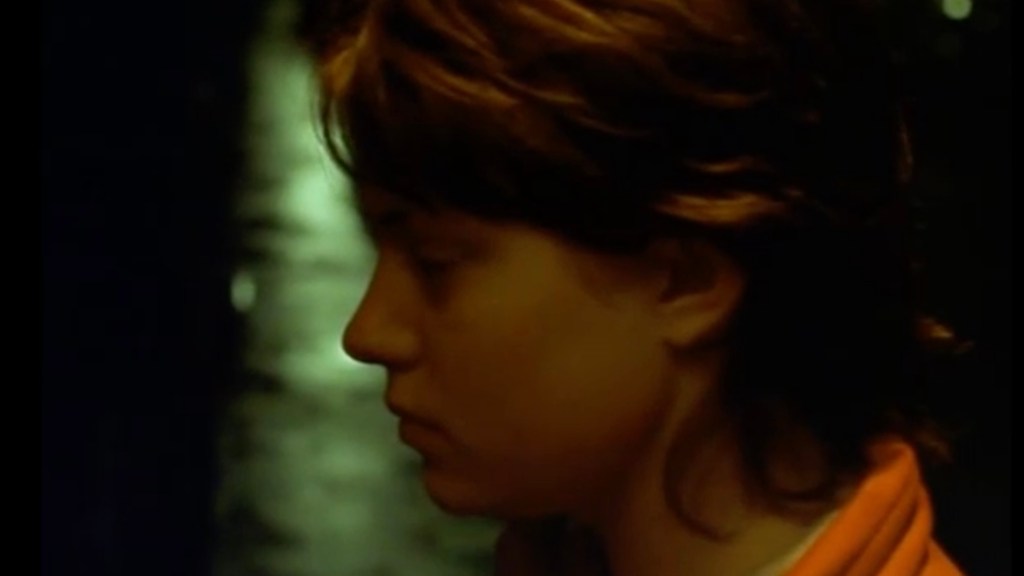
Secondly, they use sound and images more than words to drive the film (Mosley, 2013).
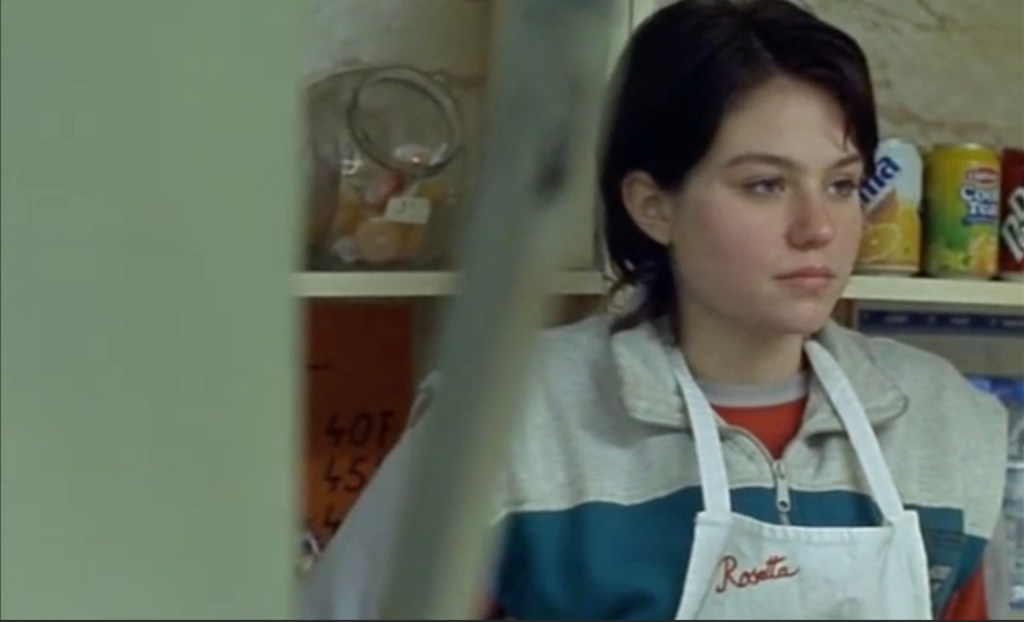
We can get it from the shooting method. In this film there have lots of extreme close-ups and over shoulder held, the combination of these two method contributes to a keen sense of physicality.
The distance between Rosetta and camera is close, by this way create the first person of view. And physical movement is the boundary between inner self needs and social external needs (Morgan, 2008). So in that case, one can feel not only the rhythm of events, but also Rosetta’s rhythm, strength and even breathing. Throughout the film many times and repeatedly Rosetta pretended to get off from a place, and then after a few turns before returning to the trailer park. This long and repetitive journey is not deleted by the director, because it is these long distances that make the audience feel that she lives on the edge of the city, and the repetition of changing shoes makes the audience intuitively feel her difficulties from Rosetta’s physical behavior.
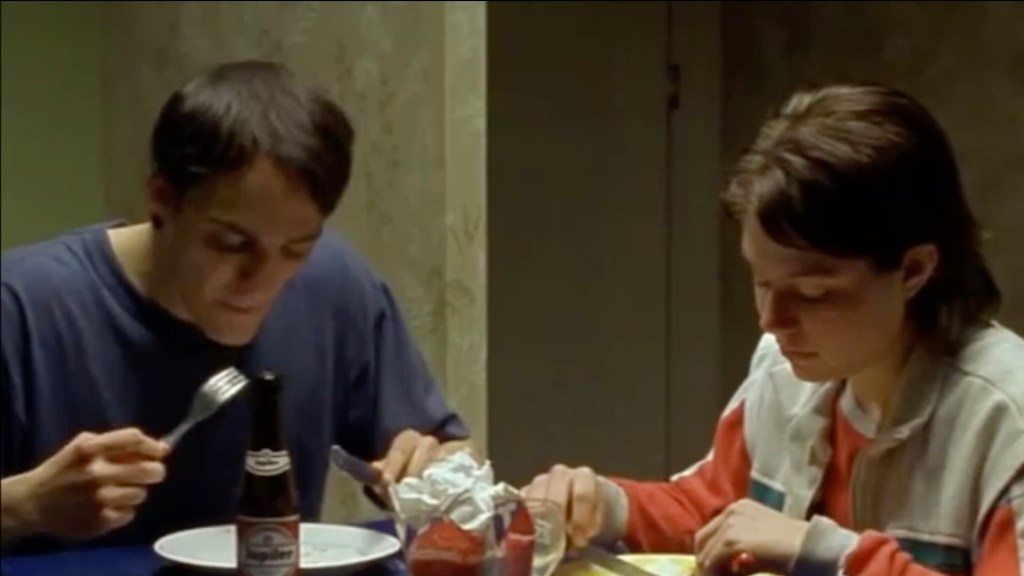
Rosetta lives not only on the edge of society, but also on the edge of her own ability to cope (Morgan, 2008).
So in that case, one can feel not only the rhythm of events, but also Rosetta’s rhythm, strength and even breathing. Throughout the film many times and repeatedly Rosetta pretended to get off from a place, and then after a few turns before returning to the trailer park. This long and repetitive journey is not deleted by the director, because it is these long distances that make the audience feel that she lives on the edge of the city, and the repetition of changing shoes makes the audience intuitively feel her difficulties from Rosetta’s physical behavior. Rosetta lives not only on the edge of society, but also on the edge of her own ability to cope (Morgan, 2008). Which is reflected in the plot, where Rosetta is repeatedly fired or even replaced, and she has no income to support the family or even herself. After trying hard to get her job back and be denied, she wrestling with the person who has replaced her in her new job. The use of handheld filming here makes this sequence much more uncomfortable and uneven, thus inadvertently increasing the audience’s sympathy for Rosetta’s fate.
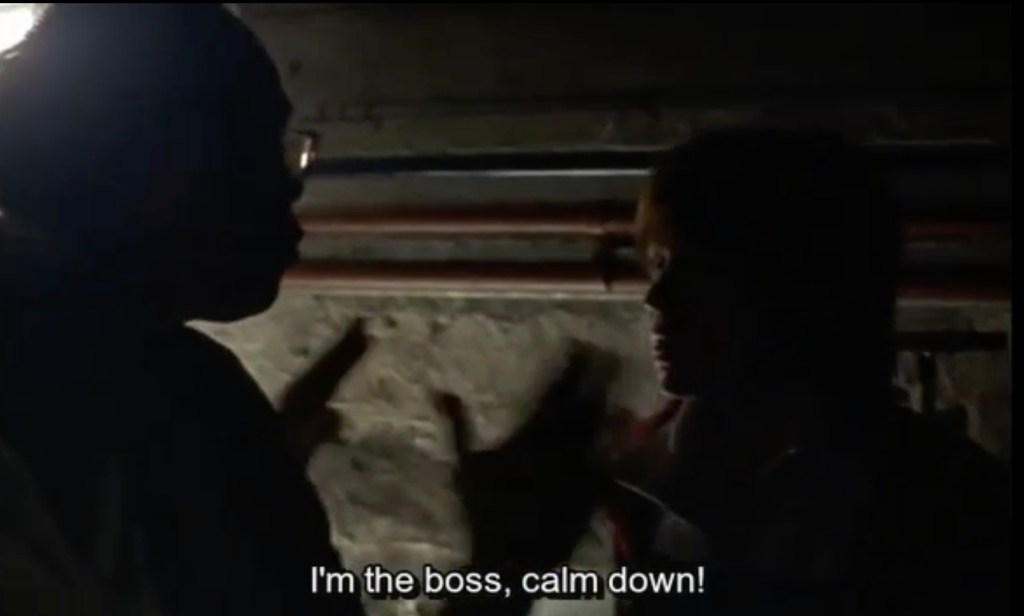
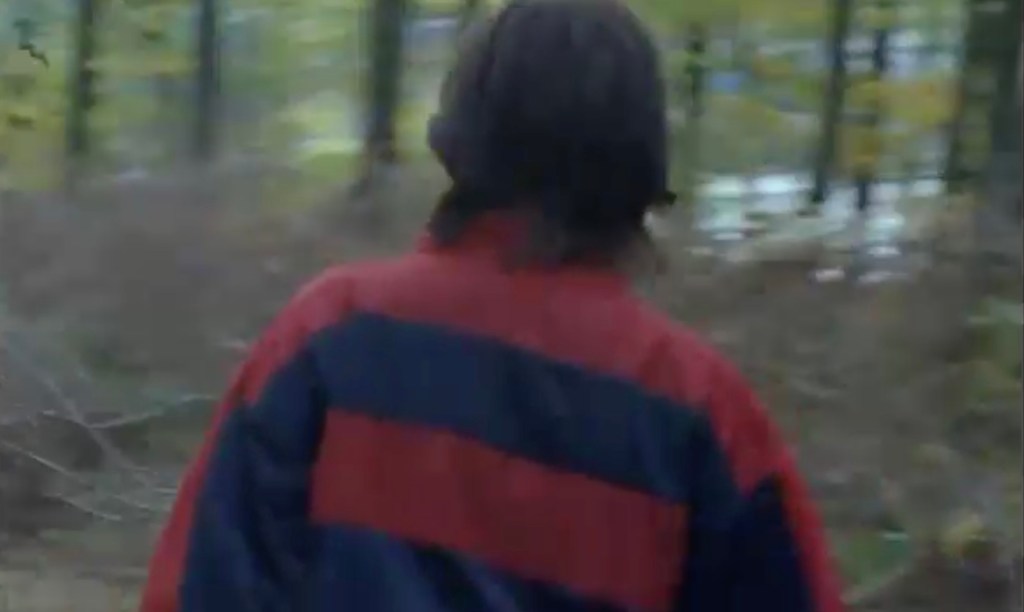
Some viewers have suggested that hand-held photography is extremely uncomfortable, but here the discomfort caused by this technique is similar to the pain Rosetta felt when she lost her job. Only when the audience also feels the discomfort can they be inspired to sympathize with and pity the protagonist’s current situation. The turbulent scenes also suggest the changing social environment and Rosetta’s unsettled life. Later on, Rosetta visits Riquet’s home, and this episode is shot in a static manner, in contrast to the dynamic handheld shots that precede it. And the Dardenne brothers use very close framing to make the main character’s psychological changes to be enhanced. Because in such close framing, any of the character’s eyes and movements will be magnified and easier for the audience to capture. And handheld photography gives the actors more freedom and space to play, reducing the constraints brought about by a fixed camera position. Because a fixed camera position often requires careful design, including the movement of the camera, the positioning of the actors, and the lines and movements. But with handheld photography, it gives the actors the most room to play, thus showing the characters themselves in a more realistic way. The combination of extreme close-ups and handheld photography helps the cinematographer to capture sharp physical movements because everything is flexible, so handheld photography is a very helpful way for the Dardenne brothers to focus on the physical movements of the characters, and is also an effective means to bring the audience closer to the characters.
Bibliography
Dardenne, L. (2005). L’Image, la vie: le cinéma de Jean-Pierre . Brussels: CFWB.
Roemer, M. (1966). ‘The Surfaces of Reality’, in Richard Dyer MacCann (Ed.) Film: A Montage of Theories (pp.255–68). New York: Dutton.
Pippin, R. (2015). Psychology Degree Zero? The Representation of Action in the Films of the Dardenne Brothers. Critical Inquiry, 41, pp.757-785.
Mosley, P. (2013). The Cinema of the Dardenne Brothers: Responsible Realism. London and New York: Wallflower Press.
Morgan, J.(2008). The Social of Body Language in “Rosetta”. The French Review, pp.1187-1196
 COM263_Filmblog